
Gračanica

When your mother watched the plane fly into the towers you kicked her insides to let her know you were craving fish oil. Six months later you come out and time starts.
The inch of decades before birth do exist, but flatly, and only when your parents talk about them. They say the names of politicians you will study one day when you have your adult teeth. For now, you are eating fish fingers in the garden. You chew them with a mouth that is all gum.
The names Bill and Hillary are being said in the kitchen but they are less real than the TV characters you will watch before bed. Bill and Hillary are on the other side of the watershed. Your father looks out through the kitchen window and wonders if you have lived your first memory yet.
The past is flat but makes a noise. Its volume bounces around the history classroom on the second floor of your school. The First and Second World War are particularly loud but remain as formless and impersonal as museum signage. You know that your step-grandfather puts a cushion between his chair and his spine because he fell out of a helicopter whilst fighting for the World. That blue cushion is the only place where the past has a human shape.
From your viewpoint, four foot off the ground, the World looks as flat as time feels. Adults insist that it’s round, and full of more people. You cannot begin to imagine the other people. The repertoire of faces in your dreams is capped in the double digits. Your history teacher is dream face number 45.
Then you are in your mid-twenties with wisdom teeth and dreams populated by faces you don’t remember meeting and you are standing beneath a larger than life statue of Bill Clinton on Bill Clinton Boulevard which is not in America. It is in Kosovo.
The Kosovan War ended in 1999. Time’s flattest slither. Not yet history, not yet you.
Kosovo became its own country in 2008. That makes it six years your junior, a metric you can comprehend.
Twenty thousand Albanian Kosovans were raped in the Kosovan war. Some were killed but some might be the woman who smiles at you in the street, or gives you change in the bakery. Or, if she’s too young, she might be the product of rape. Or the daughter that the woman made later with a husband she loves but never told.
Clinton waves down at you with an oversized brass hand. The Kosovans thank Clinton for ending their suffering. A banner above him says Thank You America, Thank You Donald Trump.
Gračanica monastery is ten minutes’ drive away over the capital’s southern flyovers. This is a country that has dug itself out of the earth. The roads are raised on stilts. Where millions of cubic metres of soil have been taken, and why, is unclear. You are driven past the top floors of Malls and arrive before you can register that you have left. Nothing about the journey suggests that a change has taken place.
Gračanica’s bars have the same dusty sun-brollies as Pristina’s. The bakeries facades’ are black and plastic. They look as garish as those in the city and sell one euro burek that tastes the same. The left side of the town’s main road is outlined by the monastery’s wall. Its stone has the hush exclusive to organised religion.
You look at the frescos in the atrium. Signs on the walls request that you don’t take their photo, bid you put your lens, with its shuttering ability to peel layers off the present moment, away. The monastery was built in 1341 at the behest of King Milutin of Serbia.
By the doorway to the inner sanctum there are two boxed paintings, one of Milutin and one of Jesus. They have the same long white face but one wears a crown. The paintings’ plastic boxes are faded from kisses of worship, wetted already by those of the morning. Milutin and Jesus seem more bodily to you than the twenty thousand women. When history goes far enough down a borehole it finds some dimension.
A baptism is taking place inside. Through the doorway’s slip, the backs of four young men form the outer fortress of a family. You can see the outlines of heavy tattoos through their starched shirts. The back pieces emerge over their collars. Like the men’s backs, every inch of the monastery walls is covered in images.
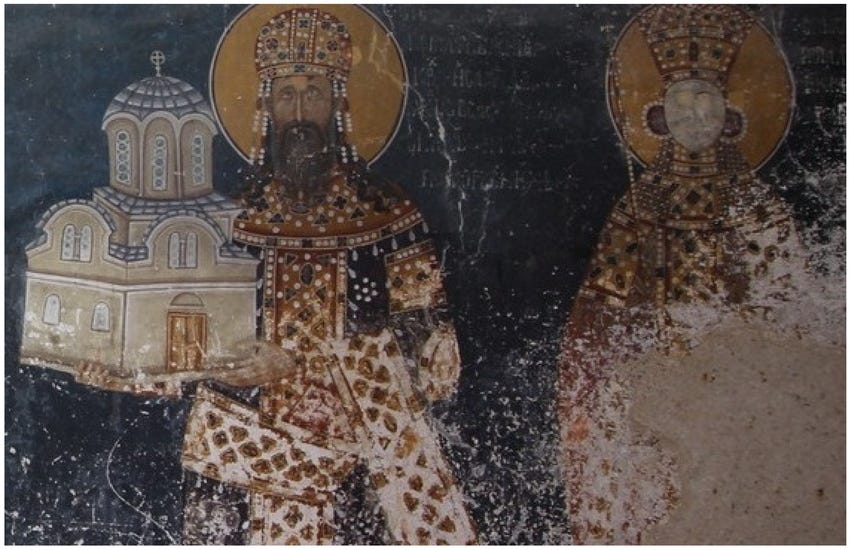
There is a fresco of Milutin on one of the central pillars. He is eight foot tall, the same oversized dimensions as Bill Clinton, and holds his monastery in his painted hands. You look at the flaking exterior of the building you are standing in and feel the monastery within a painting within a monastery within a painting, on and on. The chain of microcosms extends in both directions like centuries and the days they contain.
On the wall behind Milutin’s pillar there is a painting of Abraham. His chest cavity is filled with grey babies. They look out, maybe dead, maybe unborn, undeniably innocent. A crowd of healthy pink babies clamour to be let in by his knees.
When you leave the monastery you sit outside one of the bars. The man sitting opposite you realises first. He has read the menu where pancakes, chicken sandwich and cappuccino, are written in Serbian, not Albanian. The languages slipped over each other somewhere on the flyover. Invisibly, but not without violence, around the tenth Mall.
Looking back on this moment you will wish that your capacity to notice stretched to facets of life like this, the ones that underline the past and coax it into human shapes. Instead, you were storing away the cadence of the woman limping by and the fact that Skopsko, Superbok and Heineken were the three brands written on the Serbian sun-brollies.
You learn that Gračanica is one of Kosovo’s ten Serbian municipalities. Four are contiguous with the Serbian border, six are not. Of those six, which float around in Kosovo’s eighteen year old body, like tumours, or strongholds, depending on who you ask, Gračanica is the administrative centre. The Serbs have entrusted their enclaves to the gravity of the monastery.
Alone, later, you will look up a map of Gračanica and see it in relation to Kosovo’s wider outline. A little splatter just to the East of centre. A Serbian pacemaker in the heart of Europe’s youngest country. In your head, the map mixes with Milutin’s painted monastery, as things seen in proximity tend to do. All these little parcellings of the past within the past within the past.
The man who noticed asks a question about how you would raise your children. Two men have asked you this before. They caught themselves wondering aloud about how our children will experience the future, then quickly, not OUR children, as if you lived in a faster-paced time. This man is just asking.
You think about the Serbian infant undergoing baptism, the process of shedding teeth, and the grey baby souls wrapped up in Abraham. You consider the watershed. You say that if you have children you will do everything you can to keep them young and innocent. Children have the rest of time to be adult-shaped.

Note on the text:
I am a zelig. A cheap, stylistic copy-cat who can only emulate what she happens to be reading. In publishing this I make it your problem, not mine. Mirupafshim.


Eliza Ernaux 💘